
Close
Home » Explore » Experiences to enjoy » Parks and nature » Punta degli Stretti Cave
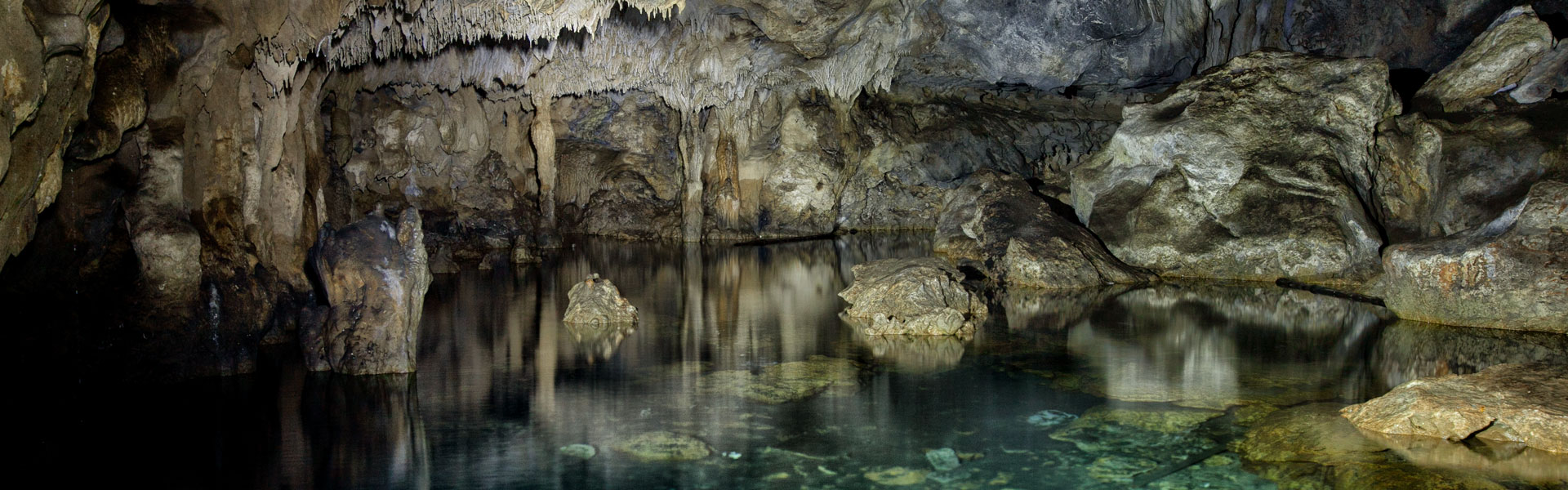
The Punta degli Stretti Cave, approximately 1 km long, is one of the largest caves along the Tyrrhenian coast. Discovered in 1841, it contains archaeological remains from Roman and prehistoric times, including fossils of lions, hyenas, and horses.
It is one of the most interesting caves along the Tyrrhenian coast, and certainly the largest of the Maremma caves, stretching about 1 km in length. The usual entrance to the cave, located in the abandoned railway tunnel, is now closed to the public as the tunnel is private property. The entrance is at an elevation of 4–5 meters above sea level, and there are no significant elevation changes (max -3 meters) along the entire 930-meter length of the cave, which runs horizontally.
It begins with a vast chamber largely occupied by a small lake of clear water, which can be navigated by rowboat. Beyond this, a series of tunnels and chambers follow one after another until reaching two more ponds, which can be easily crossed via narrow passages along the walls. It is also known as the Grand Duke’s Cave, in honor of Leopold II of Lorraine, who commissioned the work to improve the Orbetello-Porto S. Stefano road during which it was discovered (1841).
In 1912, during the construction of the Orbetello-Porto S. Stefano railway line, Roman-era archaeological remains were discovered, along with some older artifacts dating backto the Bronze Age, such as arrowheads and stone tools, as well as human teeth and jawbones. In October 1927, the site was systematically explored by members of the Roman Speleological Society, who were responsible for drawing up the first floor plan.
According to a study conducted in the late 1950s, we can define the Punta degli Stretti Cave as the remnant of a pre-Pliocene underground hydrographic network (dating back 6–7 million years) formed within diklastic systems whose structures are affected by the fracture zone associated with the pyrite and manganese mineralization between Poggio Mortaio and Punta degli Stretti.
Fossils of lions, hyenas, wolfdogs, foxes, deer, fallow deer, and horses have been found in the post-Tyrrhenian breccia layers. Today, the area is still home to fauna species of primordial origin, such as Salentinella denticulata and Monadela argentarii, two species of tiny endemic crustaceans collected in 1950 along with numerous specimens of aquatic fauna: ostracods, copepods, amphipods, and thermosbenacians. Not to be forgotten are the Chiroptera, specifically the Tynolophus ferrumequinum bat, the small Catopide Bathisciola derorasi, and a particular type of wingless grasshopper, scientifically known as Dolichopoda (Capraiacris) baccettii.
In 1995, a group of divers explored the cave and spotted an albino eel—likely blind due to the complete lack of light—as well as other eel-like creatures measuring 25–30 centimeters in length.
Without a doubt , the Punta degli Stretti cave deserves to be protected as a natural monument. The Municipality of Monte Argentario has taken steps in this directionArgentario aware of the cave’s significant importance both from a scientific standpoint and for its purely tourist appeal,Argentario intends to launch a restoration project to make it known to the many visitors who stop to stay at theArgentario.
Registered in the Regional Land Registry under number T/GR-0250, it is located on Sheet 135 (III NE, Porto S. Stefano) at coordinates 01°16'54" W – 42°25'54" N.
The Punta degli Stretti Cave is located in Monte Argentario, along the road connecting Orbetello to Porto Santo Stefano, near the turnoff for the Convent of the Passionist Fathers.The cave’sentrance is man-made, hidden by vegetation and not easily visible.
To visit the cave, you must joina guided tour, asaccess is permitted only with experienced guides. The trail to the cave is accessible only on foot; it is of moderate difficulty and takes about 3 hours. During the hike, you will pass through narrow, muddy passages, and at times you will need to crawl on the ground.
This excursion requires a good level of physical fitness and is suitable for people with good mobility, aged 11 and older. The guides providethe necessaryequipment, such as a wetsuit, helmet, and headlamp, so you can safely explore the interior of the cave, which also features underground pools and constant temperatures between 16 and 20 degrees.
To provide the best possible experience, we use technologies such as cookies to store and/or access information on your device. By consenting to these technologies, we may process data such as your browsing behavior or unique identifiers on this site. Failure to consent or withdrawal of consent may adversely affect certain features.

