
Close
Home » Explore » Experiences to enjoy » Parks and nature » Convent of the Presentation
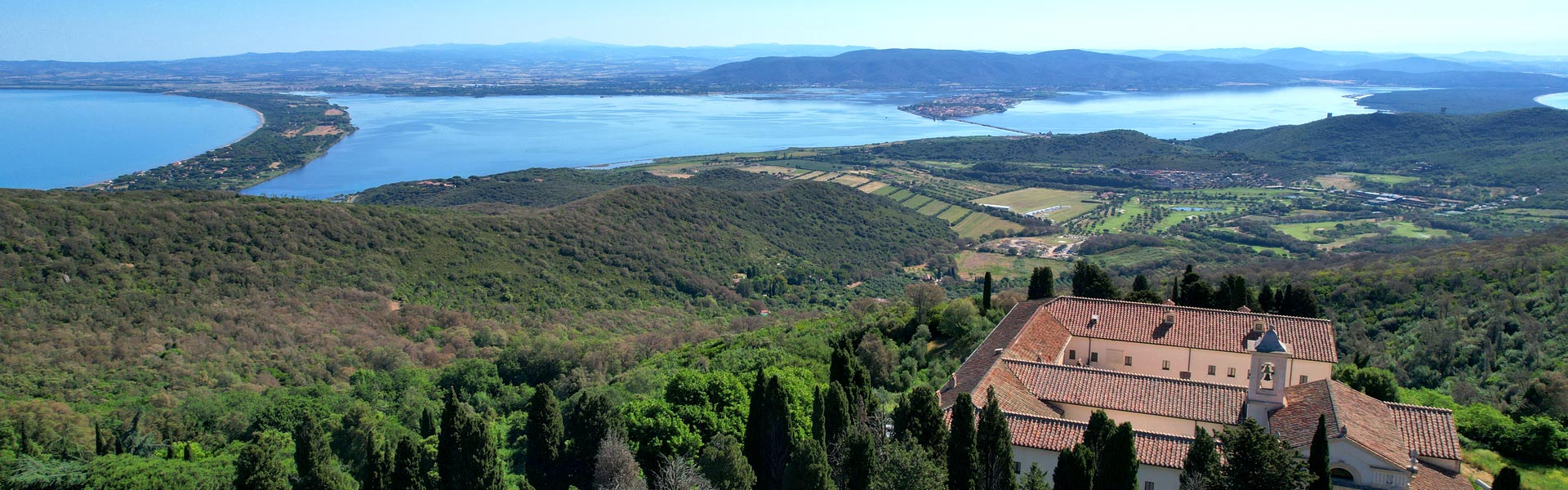
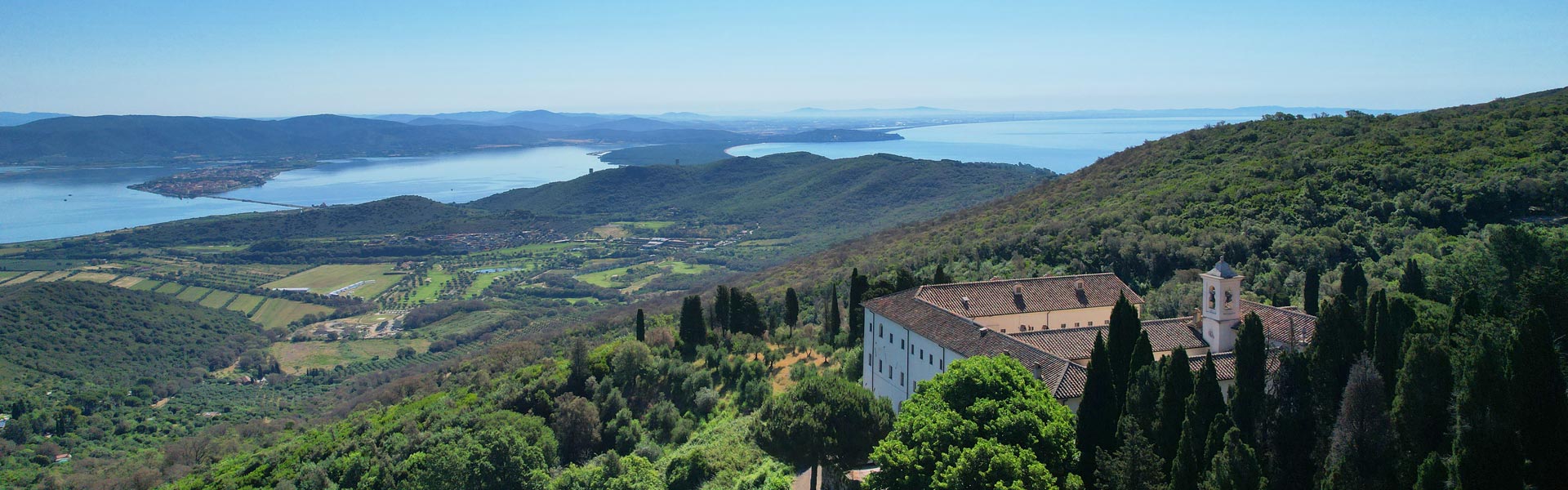
Founded in 1731 by the mystic Paolo Danei, known as Saint Paul of the Cross, the Ritiro della Presentazione is located on Monte Argentario. Originally intended for the Passionist Fathers, the monastery has undergone numerous transformations over the centuries, acquiring important works of art and gaining prestige.
On July 15, 1731, the community of Orbetello granted the applicant Paolo Danei (1694–1775) of Ovada in Piedmont a plot of land on Monte Argentario to build a new convent there; two years later, on March 4, 1733, the cornerstone of the Ritiro della Presentazione was laid. Due to the War of the Polish Succession (1735–1737), which saw the State of the Presidi at the center of violent armed clashes, construction dragged on for several years until September 14, 1737, when Monsignor Giovanni Maria Moretti, Vicar General of the Abbey of Tre Fontane, inaugurated the church and convent of the Passionist Fathers.
The founder, recognized as the greatest mystic of the 18th century and celebrated as one of the most eloquent missionaries and preachers of the century, was beatified in 1853 and canonized in 1867 by Pope Pius IX. The Congregation of the Passion of Jesus Christ, which he founded, was authorized in 1723 by Pope Benedict XIII, while the Rules were approved by Benedict XIV on May 15, 1741. The Congregation, as a religious order, was approved by Pope Clement XIV in 1769. Following the approval of the Rule, the first chapter was held at the Retreat of the Presentation on April 10, 1747. During this chapter, Paul, accompanied by his brother John Baptist, was unanimously elected the first Superior General, a position he held until the day of his death.
Meanwhile, in 1761, the first Passionist novitiate dedicated to St. Joseph was inaugurated 800 meters from the Retreat, while in 1771, with the collaboration of the venerable Mother Crocifissa Costantini, the Saint founded the Passionist Cloistered Sisters.
It is said that the Retreat was built according to a simple plan that the saint drew on the ground with his staff. Following repeated and often elaborate renovations carried out over time between the mid-18th century and the late 19th century, the building reached its current state.
The church was expanded in 1739 with the construction of a chapel dedicated to St. Michael the Archangel, and in 1746 with the addition of a chapel dedicated to Mary Magdalene. The vault was restored in 1779, and the bell tower was erected in 1780. The façade, completed in 1856, features a neoclassical style.
The interior houses several notable works: *The Madonna and Child Presenting the Convent’s Blueprint to St. Paul of the Cross* by Pietro Aldi (1880); *The Presentation of Mary in the Temple* by Sebastiano Conca; and *The Madonna and Child Holding the Sacred Heart with St. Joseph in the Background* by Pompeo Batoni. The Madonna Regina del Monte Argentario, from the 18th-century Roman school, is highly venerated. On the altar of the right transept is an 18th-century painting depicting Mary Magdalene, and on the left altar is a Saint Michael the Archangel.
The crypt houses both the statue of the saint and a bas-relief depicting his arrivalArgentario. Finally, inside the church, visitors can admire a bronze urn containing the remains of the young Passionist, the Venerable Galileo Nicolini, a work by the sculptor Tito Amodei.
The convent underwent various and radical transformations with the addition of two wings of rooms. Inside, there is an excellent painting from the Venetian school depictingThe Last Supper, two beautiful paintings— *Madonna and Child* and *Saint Joseph with the Child* by Antonio Cavallucci—and other devotional paintings from more recent periods.
On the occasion of the Jubilee of 2000, the church was elevated to the status of a diocesan sanctuary, and on December 12 of that same year, it received a visit from Pope John Paul II.
The Convent of the Presentation in Monte Argentario has a public parking lot located a short distance from the building; however, this is not specifically marked as accessible for people with disabilities. The convent is situated on hilly terrain, and the main entrance is reached via unpaved roads and paths, which may be difficult to navigate for those with limited mobility or who use a wheelchair. Additionally,the main entrance has steps and lacks ramps, making access not entirely easy for people with mobility impairments. Inside, the small church, decorated in the Baroque style and rich in significant works of art, may also be difficult to access due to the presence of steps and the layout of the interior spaces.
To provide the best possible experience, we use technologies such as cookies to store and/or access information on your device. By consenting to these technologies, we may process data such as your browsing behavior or unique identifiers on this site. Failure to consent or withdrawal of consent may adversely affect certain features.

