Close

Home » Explore » Routes and itineraries » Hiking Trails » 28 – Caravaggio Trail
Starting point: Stone and Silence
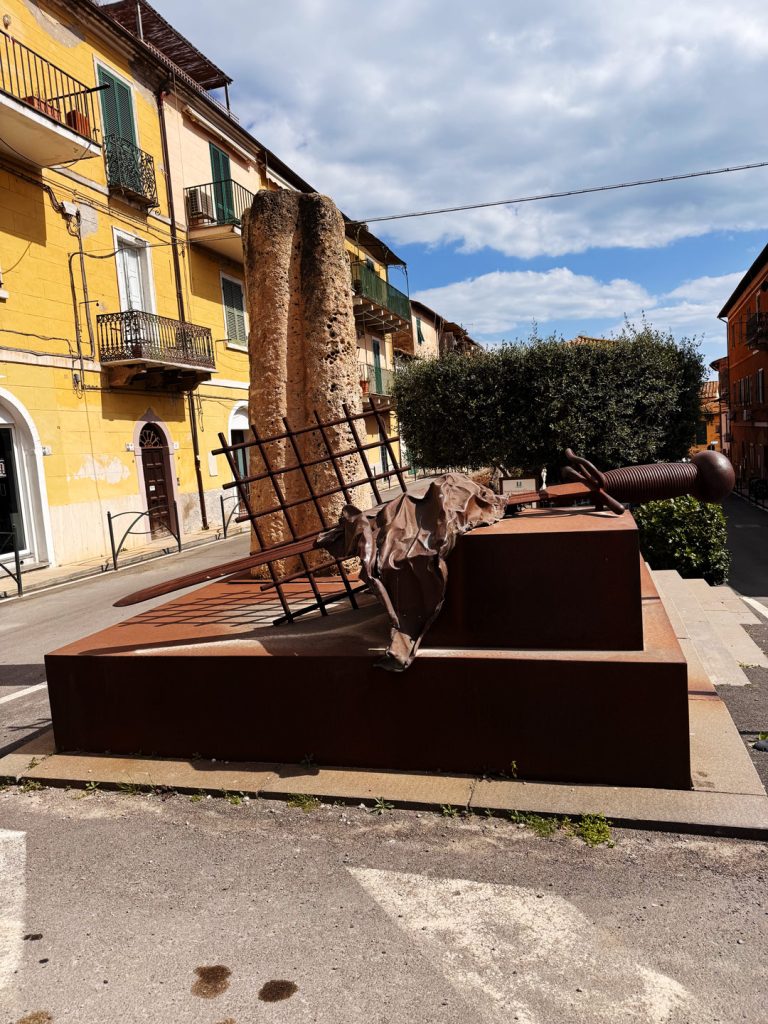
Departure from the monument at the site of Caravaggio’s first burial
This is where it all begins and ends. This monument — a Roman column, a sword, a grate, and a hammer made of Corten steel — is no ordinary cenotaph. This is believed to be the exact spot where the remains of Michelangelo Merisi, known as Caravaggio, the painter who revolutionized European art and who died in this village on July 18, 1610, alone, ill, and on the run. The monument was built in 2002 by architect Giuseppe La Fauci. For centuries, nothing was known: no grave, no definitive record, no shared memory. Then, in 2001, what scholars believe to be the painter’s death certificate was found in the parish of Sant’Erasmo: “On July 18, 1610, at the hospital of S. Maria Ausilinatrice, Michelangelo Merisi da Caravaggio, painter, died of illness.” A fiery life, concluded in a few lines of a parish register. His remains—identified through DNA analysis in 2010, exactly four hundred years after his death—were buried in the old cemetery of San Sebastiano, where the center of the new village now stands. From here, from this silent stone at the entrance to the village, the journey begins: in the footsteps of a man whom Porto Ercole did not seek, but whom Porto Ercole has never forgotten.
Murals in Porto Ercole
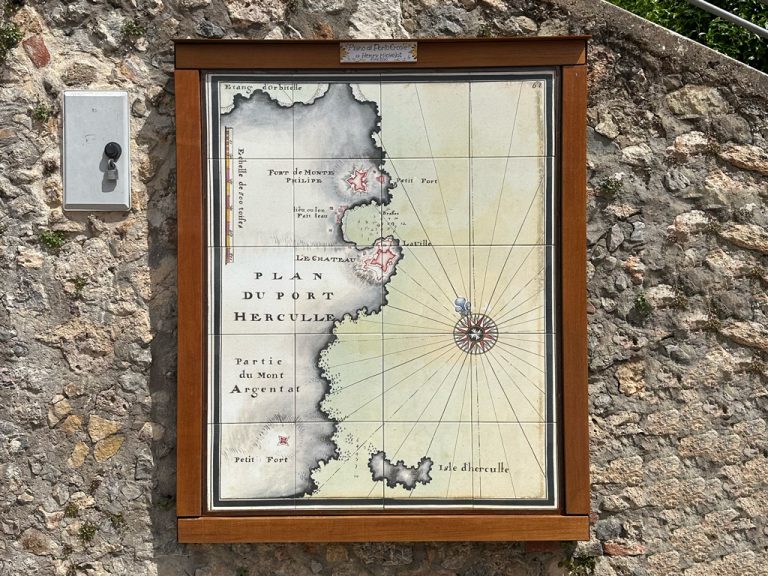
Map of Porto Ercole
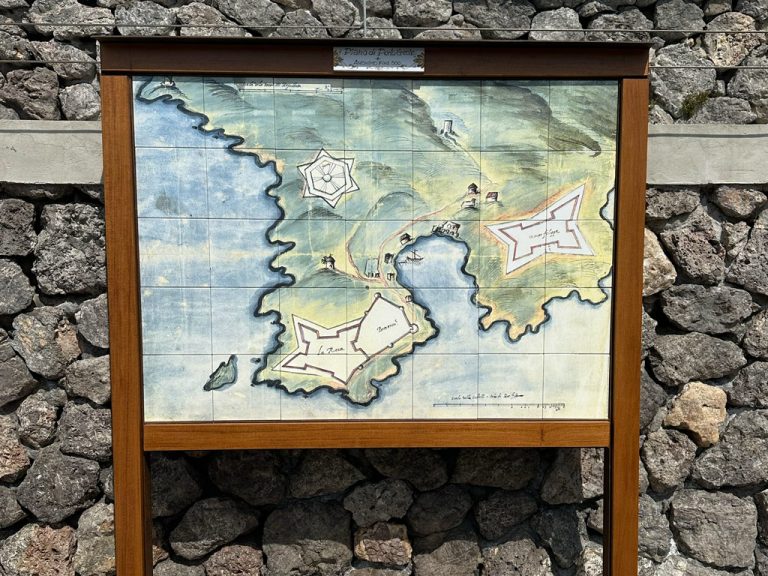
The panel provides a concise overview of the layout of Porto Ercole during the height of the modern era, emphasizing the fortifications—as is often the case in certain types of cartography. The map is geodetic, meaning it is drawn to scale, and depicts the harbor area with a small settlement surrounded by two forts, the Rocca Spagnola and Forte Filippo, while Forte Stella is shown further away. This image is the result of many transformations, beginning with the medieval castle, which was already remodeled in the 15th century by Sienese architects of the caliber of Francesco di Giorgio Martini to meet new defensive needs, and culminating in the elegant solutions of the Spanish architects who built fortresses with distinctive arrow-shaped bastions perched atop the hills.
The Old Harbor and the Caves – Murals in Porto Ercole
Towards the Sea
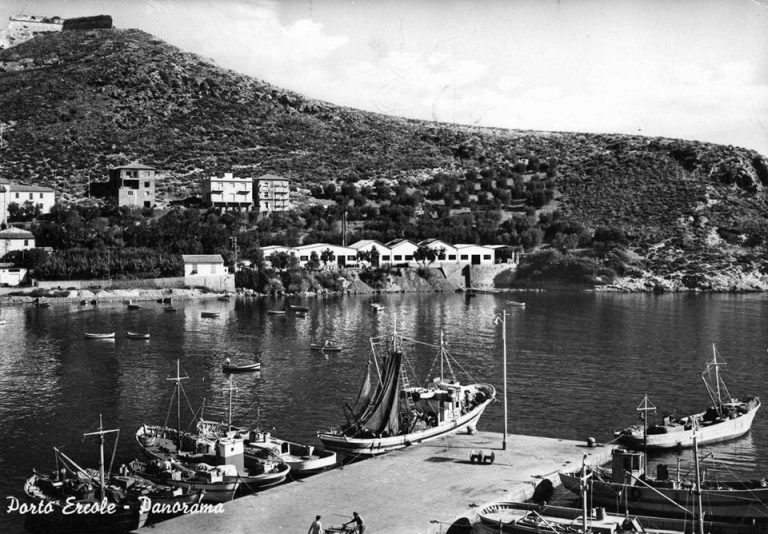
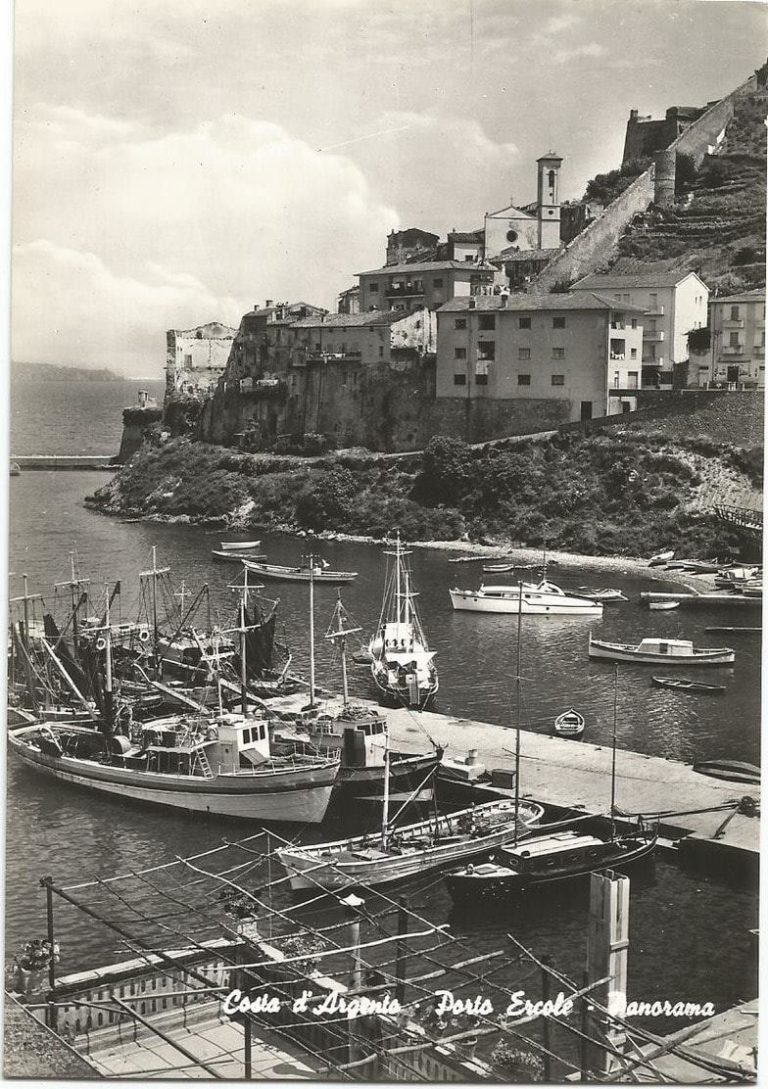
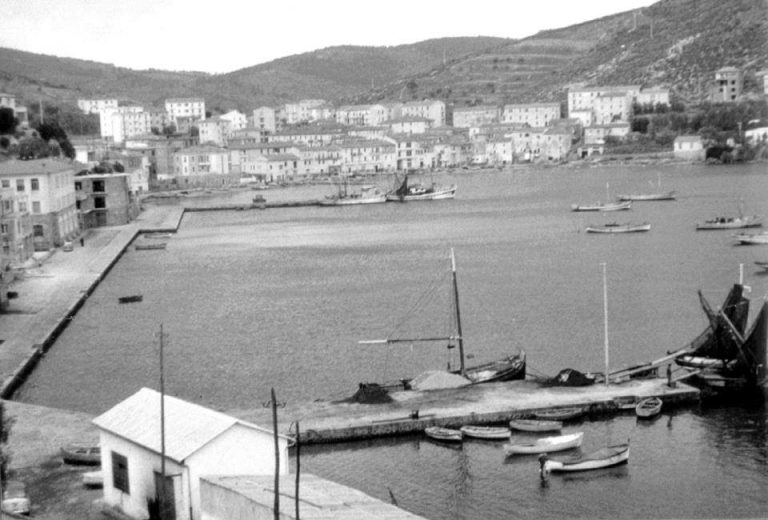
Before the Spanish forts were built, before the medieval village existed, and even before the Romans arrived, this cove was already a shelter. The Argentario promontoryArgentario reflected in the sea for millennia, and Porto Ercole — the Portus Herculis of ancient sources — is already mentioned in 137 B.C., when the consul Gaius Ostilius Mancinus set sail from there for Spain under an unfavorable omen. On the northern side of the harbor, historical maps indicate a distinct settlement: “Le Grotte”, or “Pian delle Grotte,” or sometimes “fishermen’s houses.” The name is not evocative by chance: recent studies have identified those buildings as the remains of Roman structures with vaulted roofs — cisterns or cryptoporticoes — likely part of a large building linked to port activities, even equipped with a concrete pier. This was the port that Caravaggio saw upon arriving from Naples in the summer of 1610, on a felucca laden with hope and three paintings destined for Cardinal Scipione Borghese. This port was his last chance for redemption. But the felucca had already set sail. And Caravaggio was left behind.
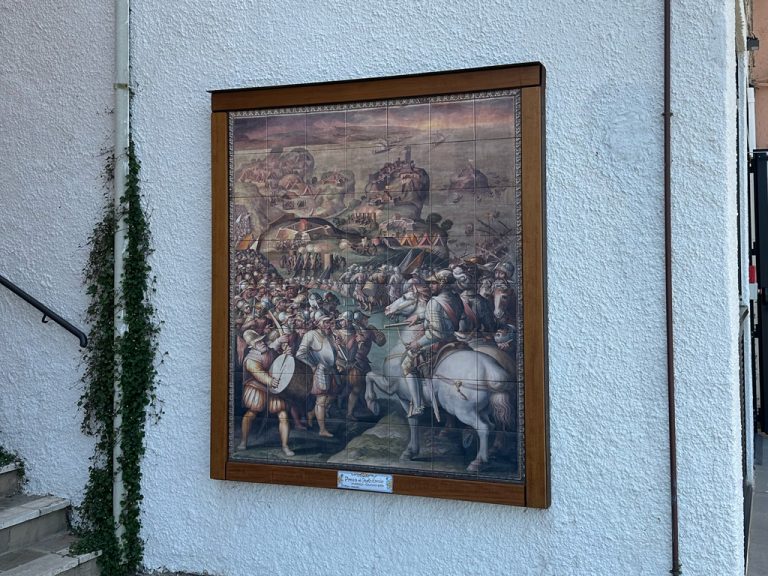
The mural by Giorgio Vasari depictsthe military episode that took place following the surrender of Siena on April 21, 1555: numerous Sienese, along with French and German troops under the command of Piero Strozzi, had taken refuge in the stronghold of Porto Ercole. After a 24-day siege, the fugitives surrendered to the ducal troops on June 20. In his *Discourses*, Vasari describes the fresco as follows: “As the Marquis [of Marignano] gradually captured the bastions and took control of the defenses, Piero Strozzi fled by galley.” The mural depicts the assault on the fortresses of Porto Ercole under the command of the Marquis of Marignano, who is depicted on horseback on the right, holding his command staff.
Murals: The Women of Cirio
Regina d’Olanda Square · The Factory and the Memory of Work
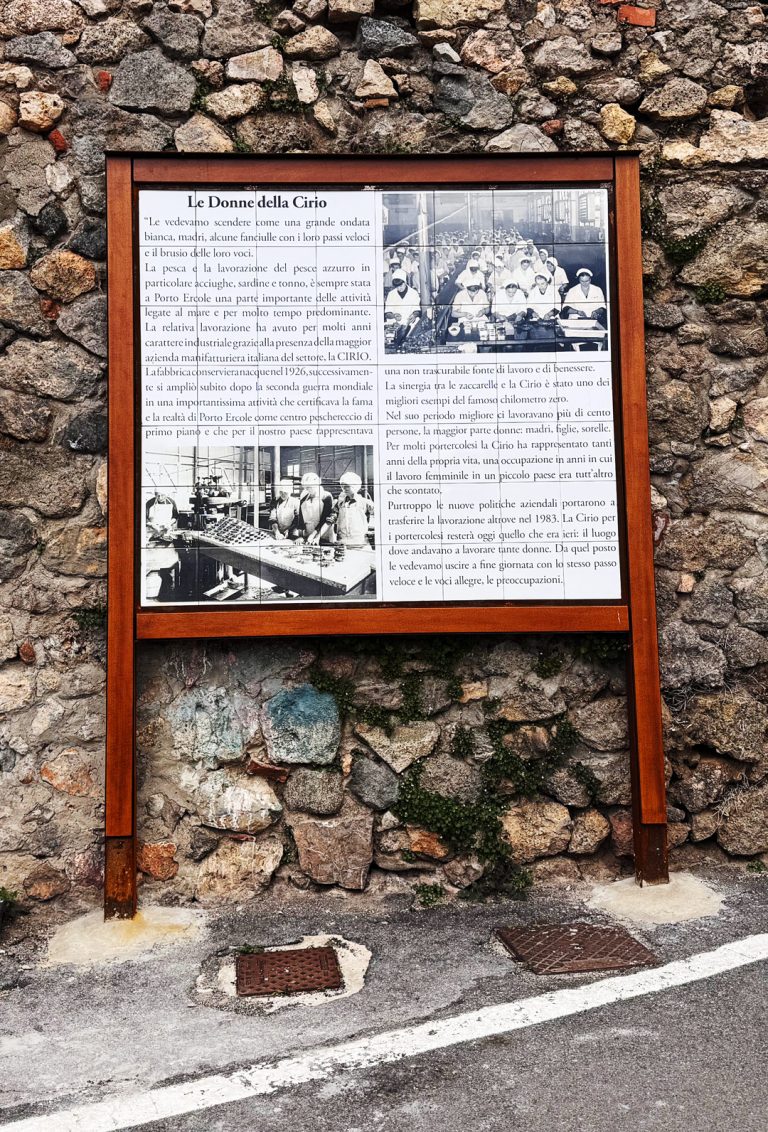
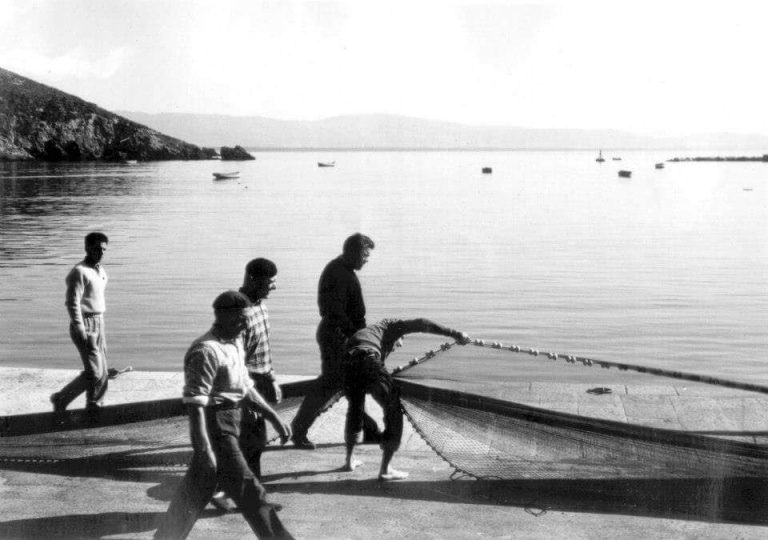
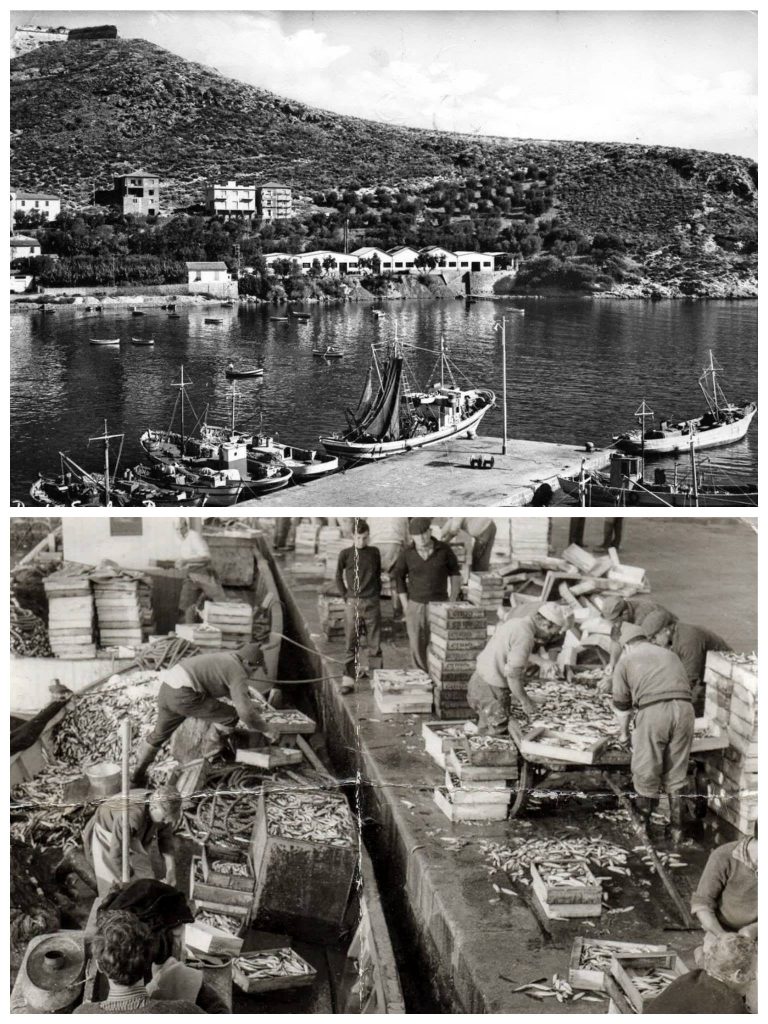
Porto Ercole isn't just about Renaissance history and picturesque tragedies. It also has an industrial legacy, made up of hands, bluefish, shifts, and quiet solidarity. The Cirio factory was founded here in 1926 to process and package canned sardines and tuna. For nearly sixty years, it was one of the town’s main economic drivers: at its peak, it employed over one hundred workers, mostly women, working in direct synergy with local fishing boats and the port. It was Cirio that gave meaning to the catch, transforming the sea into stable work, a secure paycheck, and daily dignity. The crisis arrived in 1983, when corporate policies shifted production elsewhere. The factory closed, then was demolished. Today, that area will become a lodging facility. But the photoceramic murals installed in this square—two photographs from 1966, showing women at work among milk and crates—restores that place’s authentic memory. Caravaggio died in this village as a fugitive and a painter. The women of Cirio lived there as workers. This, too, is history.
The Pirates' Landing
The Waterfront · The Sack of Barbarossa, 1544
There is a date that Porto Ercole commemorates every May with a spectacular reenactment—the Night of the Pirates—but in the summer of 1544, it was anything but a spectacle. Khair ad Din, known as Barbarossa, admiral of the Ottoman fleet and master of the eastern Mediterranean, led one of the most devastating raids the Tyrrhenian coast had ever endured. His ships besieged the harbor, and his pirates laid waste to the village, pillaging, killing, and taking slaves. The Governor’s Palace, which Agostino Chigi had built at the beginning of the century, was destroyed and had to be rebuilt by the Spanish. Porto Ercole did not yet have the defenses it would soon possess, when the Spanish would transform the promontory into an impregnable stronghold. Barbarossa’s raid accelerated everything: it was concrete proof that this port opening onto the Tyrrhenian Sea was vulnerable, and that vulnerability came at a very high cost. Sixty-six years later, another man on the run would arrive on this very same waterfront—not a pirate, but a painter—with three paintings and nowhere to turn.
Andrea Doria Promenade
Walking along the promenade
The name of this promenade is not merely decorative. Andrea Doria — a Genoese admiral in the service of Spain, one of the most powerful seafarers of the sixteenth century — was a direct protagonist in one of the most dramatic episodes in the history of Porto Ercole: thesiege of 1555. When the Franco-Sienese troops of Piero Strozzi barricaded themselves in the village awaiting reinforcements by sea, it was Andrea Doria’s fleet that closed the naval blockade, preventing any relief from reaching them. For twenty-four days, between May 25 and June 18, 1555, Porto Ercole held out. Then it fell. With it fell the last hopes of the Republic of Siena. The captured Florentine exiles were beheaded in Livorno. The soldiers ended up on Doria’s galleys. The village was sacked, the houses burned, Leone Strozzi’s tomb desecrated, and his remains thrown into the sea. Giorgio Vasari immortalized that battle in a fresco for Palazzo Vecchio in Florence, commissioned by the Medici to celebrate the victory. It is from this waterfront, looking out at the open sea, that one understands why Porto Ercole was worth a war.
Murals – La Rocca, Forte Stella, and Forte Filippo
Santa Barbara Pier
Theporthas always been important for controlling maritime traffic and as a port of call. TheAldobrandeschi countsexercised their power by buildingtowersvisible from afar, which served as territorial markers. One example is theTorre dell’Argentiera, which stands set back but is clearly visible fromPorto Santo Stefano.
During theSienese period, the need to strengthen the defenses became apparent. This need—both for defense and to demonstrate power—intensified with the establishment ofthe Spanish garrison state, which led to the construction of manyfortificationson Monte Argentario.
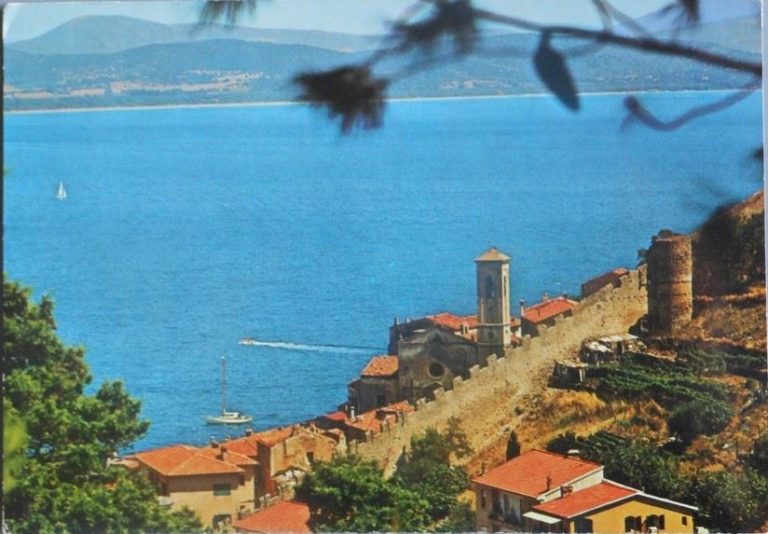
LaRoccabegan asa medieval towerwith a walled settlement, attributed to theAldobrandeschi family. Betweenthe 15th and 16th centuries, great architects such asFrancesco di Giorgio Martini,Anton Maria Lari, andBernardo Buontalenti worked on it, transforming it into aRenaissance complex. Together withForte San Filippo, it served to control the port and demonstrate Spanish power. TheForte di Santa Barbara, built by the Sienese, was constructed as an annex overlooking the sea.
Forte Stellais a smallhexagonalfortress, originally built in the16th centuryand expanded in the17th century. It played a prominent role duringthe siege of Orbetello in 1646. Itssix-pointed starshape allowed the bastions to follow the contours of the terrain. It was a monolithic structure with embrasures for cannons, allowing all weapons to be fired simultaneously. It was decommissioned only at the end of the19th century.
Fort San Filippowas built bythe Spanishwith a rectangular layout, featuring arrow-shaped bastions at the corners and adrawbridgespanning a wide moat. The defensive structures were built into the ground to blend in and evade enemy artillery. Initially, it was used to defend against theTurks, who were allies ofthe FrenchinTalamone. It also played a defensive role inthe 18th century, during the war betweenAustria and Spain. In the second half ofthe 19th century, it was converted intoa prison.
Murals – The Cannelle Tower
Santa Barbara Pier
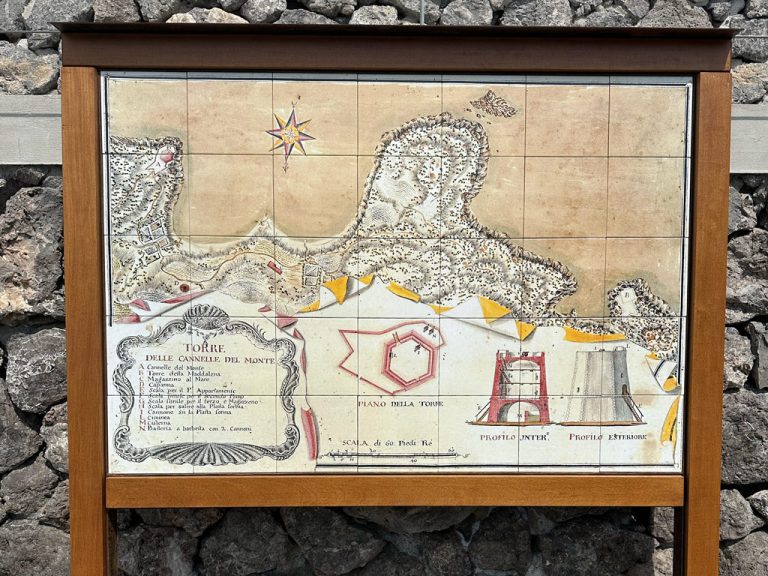
The Cannelle Tower is, on the other hand, the only hexagonal tower in Tuscany, situated close to the sea. It was built between 1566 and 1569 and still had two cannons as late as the mid-18th century.
Murals – The Torre dell’Avvoltore and the Torre della Ciana
Santa Barbara Pier
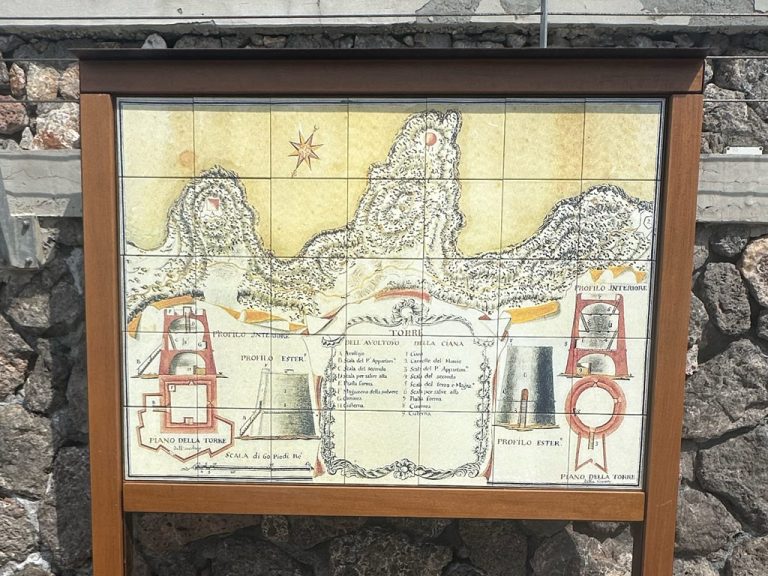
The Torre dell’Avvoltoreand theTorre della Cianaare located near thecastle of Porto Ercole. As with many other towers along the Tyrrhenian coast, theirRenaissance phase is well established, while further research and architectural studies would be needed to determine earlier phases. The square shape withbuttresses, although typical of alate medieval style, is not in itself indicative. These towers remained in use until the18th century.
Murals – Agostino Chigi and Via dei Cannoni
Walking up Via dei Cannoni · The banker who loved Porto Ercole
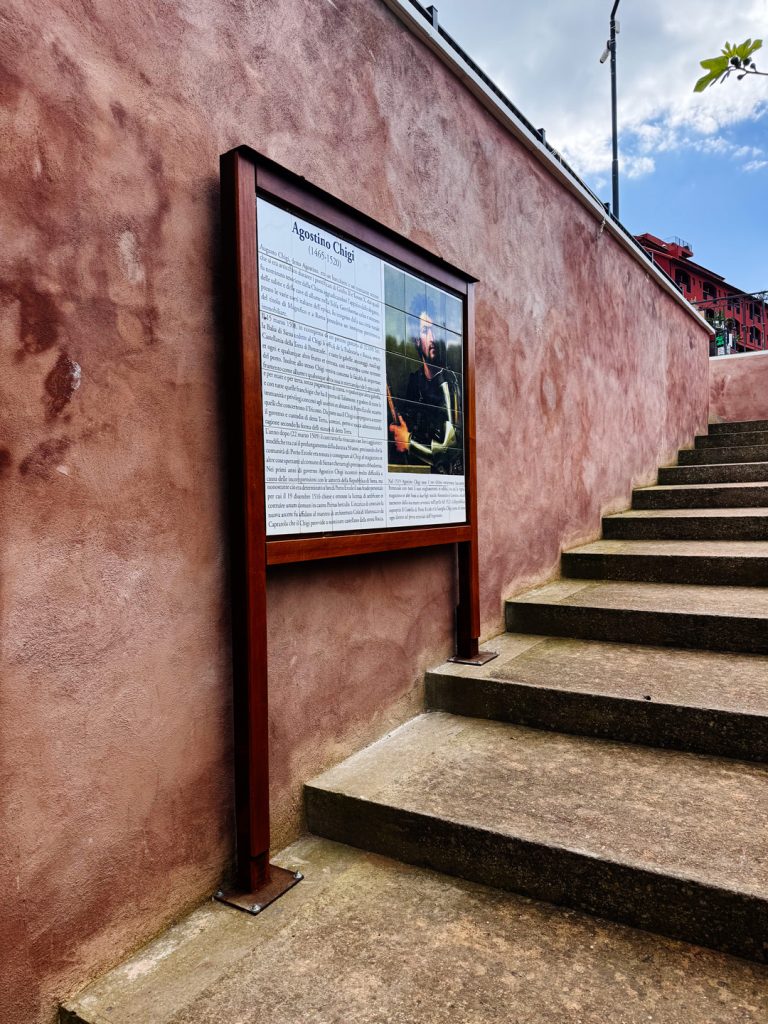
Before the Spanish, before the siege, before the pirates, Porto Ercole had a different ruler: not a military leader or a king, but a banker. Agostino Chigi — born in Siena in 1465, died in Rome in 1520 — was one of the wealthiest men of the European Renaissance. He held the concession for the alum quarries north of Rome, financed popes and cardinals, built sumptuous villas, and was a patron of Raphael. And he had obtained from the Republic of Siena the concession for Porto Ercole for fifty years. Not merely as a possession: Chigi invested in the port, used it as a base for his commercial activities, carried out improvements to the landing area, and had the initial section of the Governor’s Palace that can still be seen in Piazza Santa Barbara. Via dei Cannoni bears its name fittingly: it was here that the Chigis built and the Spanish cannons defended. Then came Barbarossa, then came the Spaniards, then came Caravaggio. Chigi’s port had become a fortress. But the fortress could do nothing for the man who died there in the summer of 1610.
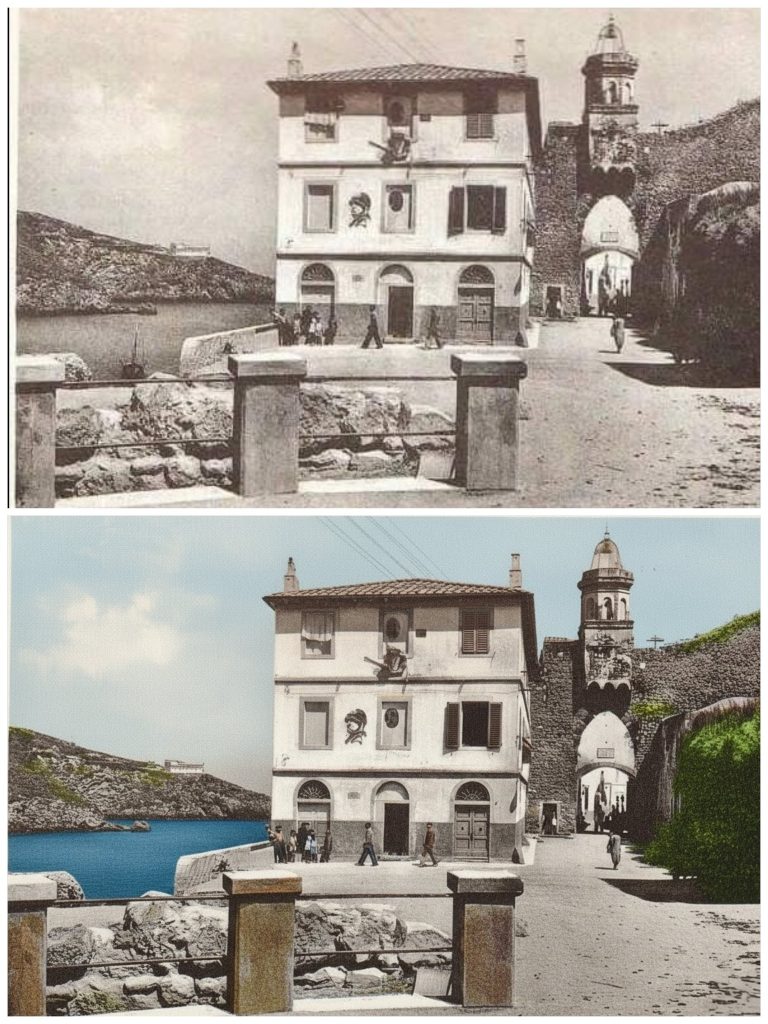
Pisan Gate
The entrance to the village · The threshold between worlds
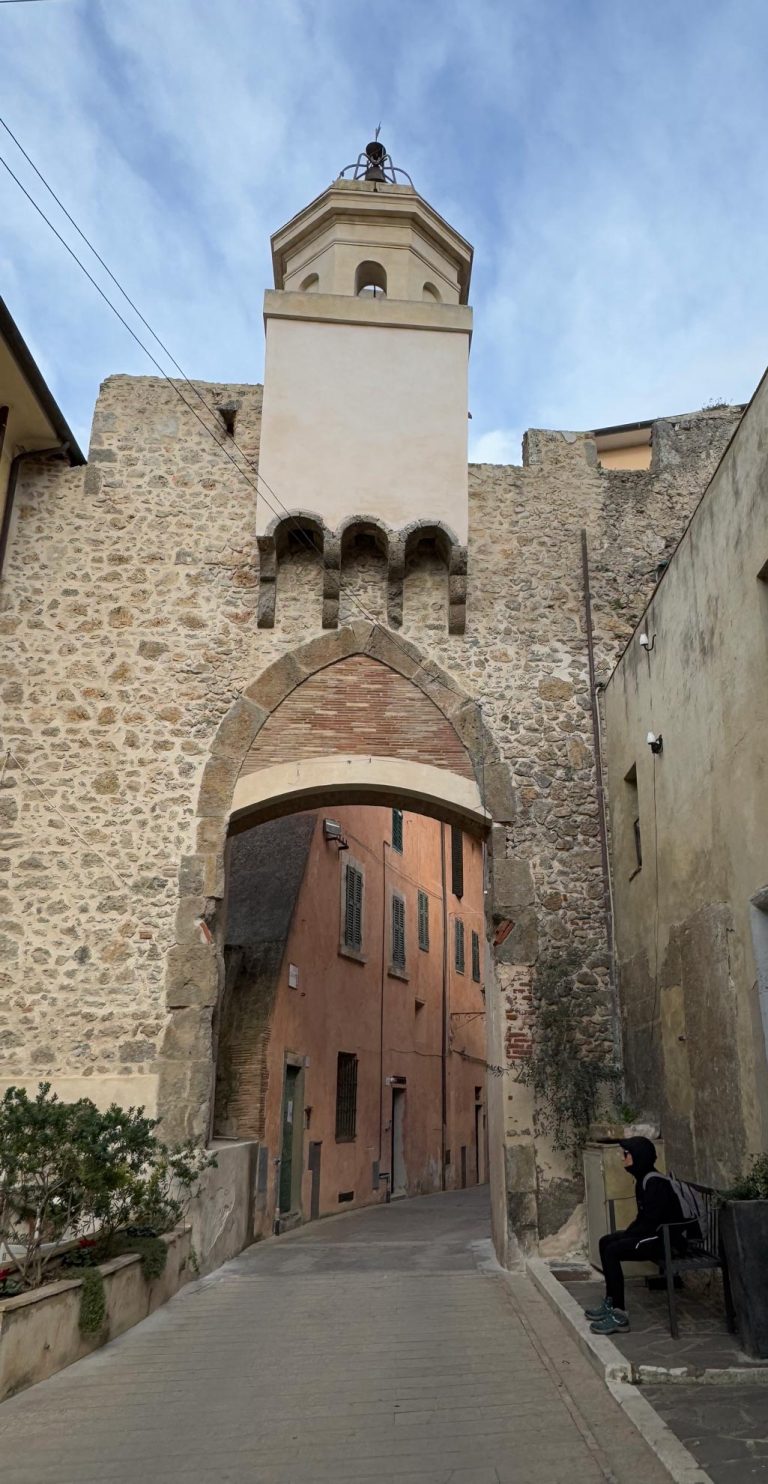
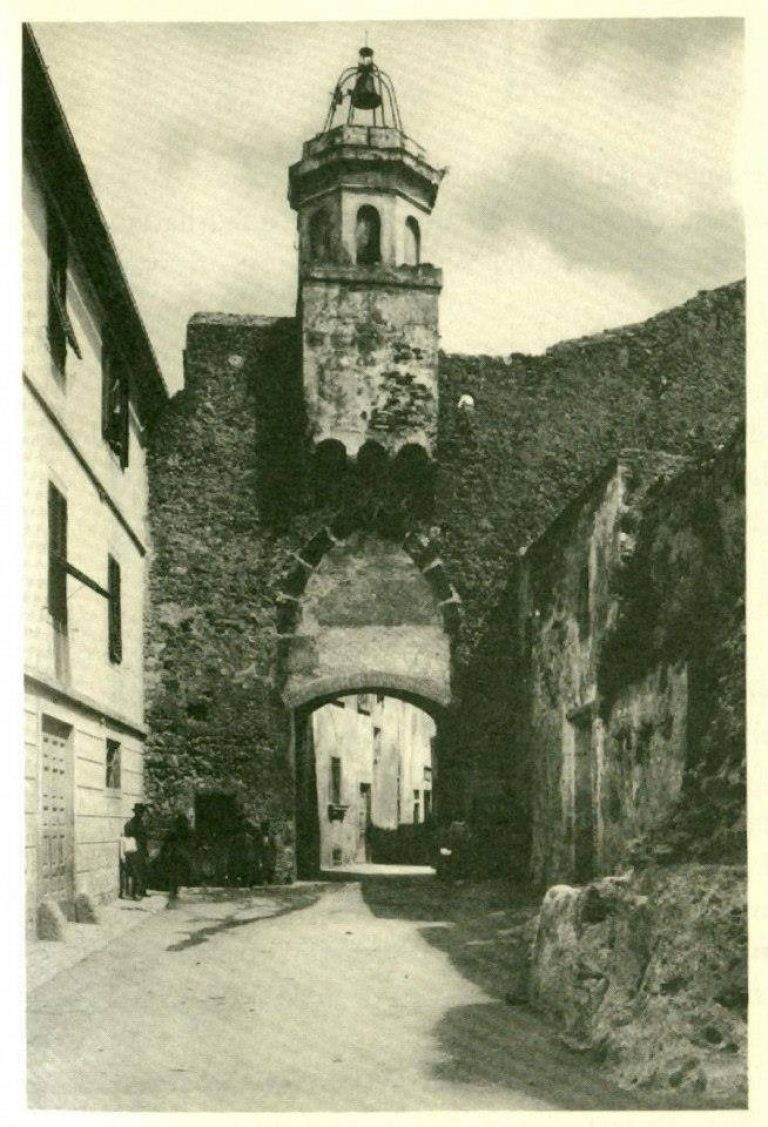
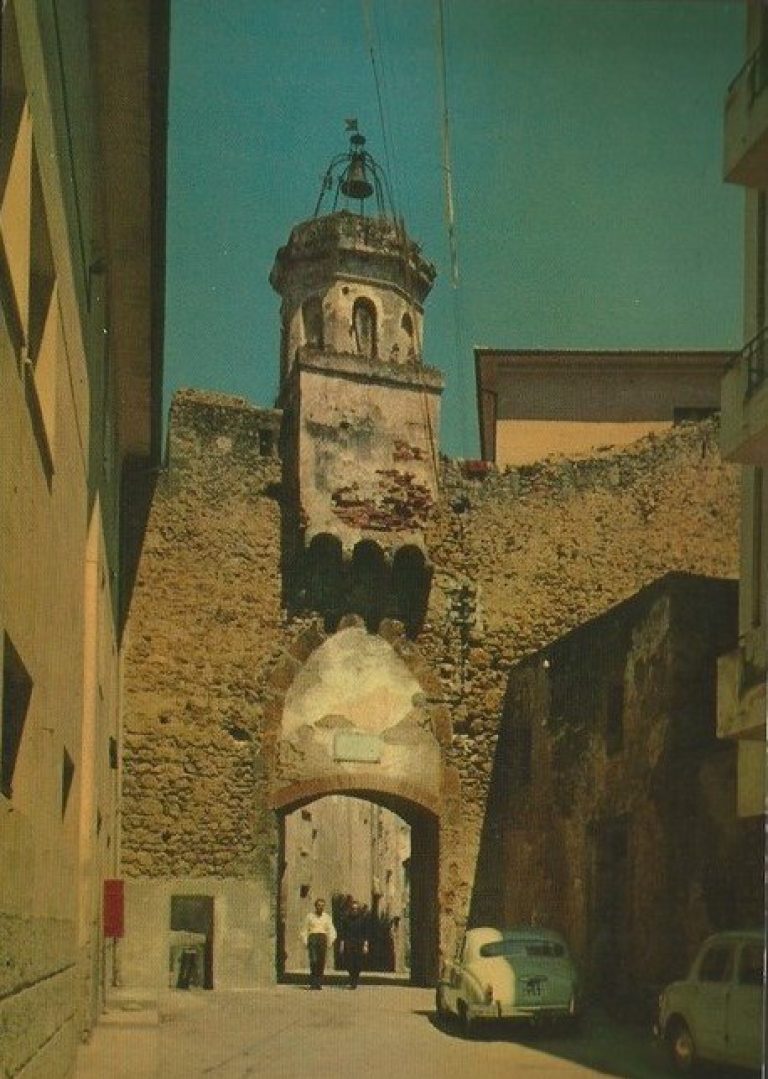
This door is a threshold in the most literal sense. On one side lies the harbor, the sea, the Tyrrhenian Sea stretching toward Naples, Malta, Rome—the restless world in which Caravaggio had lived out his flight. On the other side lies the walled town, with its narrow streets carved into the rock, its Spanish palaces, its defensive geometry. The Porta Pisana — built by the Pisans in the Middle Ages and later modified by the Spanish in the 16th century — served as the gateway between these two worlds. Those who entered here passed under the sovereignty of the State of the Presidi, under the authority of the Spanish governor. Porto Ercole was, formally, Spanish territory from 1557, when the Treaty of Brussels had ceded it along with Porto Santo Stefano, Orbetello, Ansedonia, Talamone, and Porto Longone. A fortress administered from Naples, garrisoned by soldiers, governed by decrees. Caravaggio, who had a death sentence had been hanging over his head since 1606, knew full well what it meant to walk through a gate like that. And he went in anyway.
The gateways
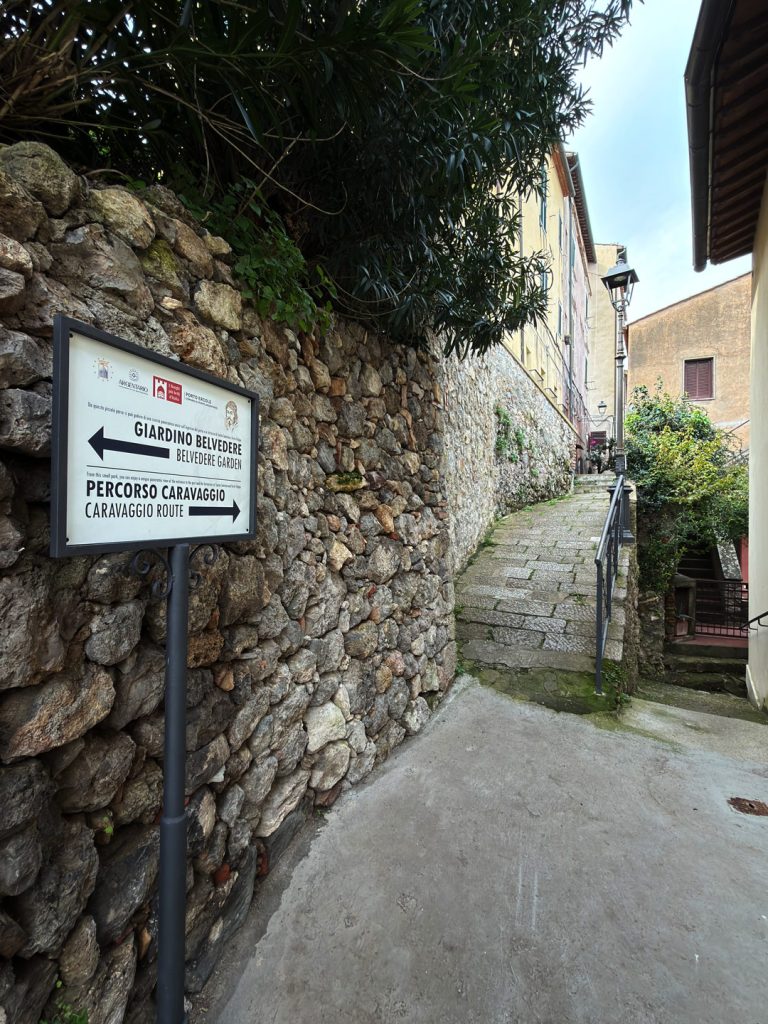
Follow the main road and the signs for the Long Route
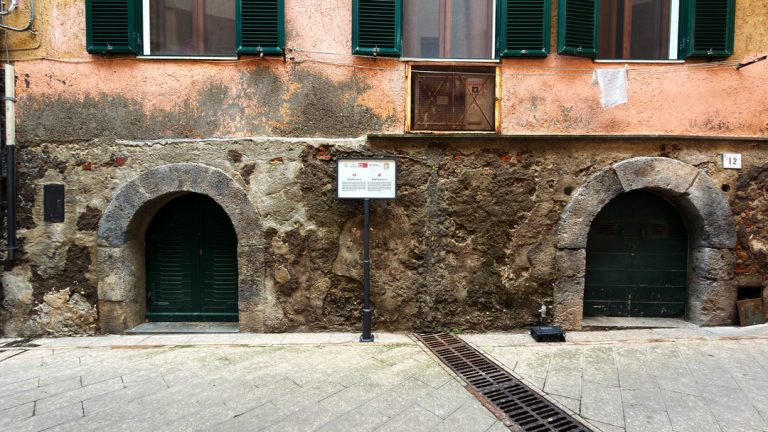
The stone archways that line the narrow streets of the historic center are not merely architectural features. They are the signature of five centuries of successive rulers, each of which has left its own style carved into the local stone. The Gothic pointed-arch portals are the oldest, dating back to the Sienese period—when Porto Ercole was a thriving commercial port, capable of attracting bankers like the Chigi and architects like Francesco di Giorgio Martini. The round-arched Renaissance portals, with their ornate frames, mark the transition to Spanish rule. Those bearing coats of arms and Latin inscriptions commemorate the families of the garrison, the governors, and the officers who were born, lived, and died here for generations. Caravaggio passed under these portals in the summer of 1610. He saw them while ill, feverish, and desperate. He did not know—could not have known—that four hundred years later his name would give its title to the town’s main avenue, and that Porto Ercole would claim him as its own.
The Governor's Palace and Santa Barbara Square
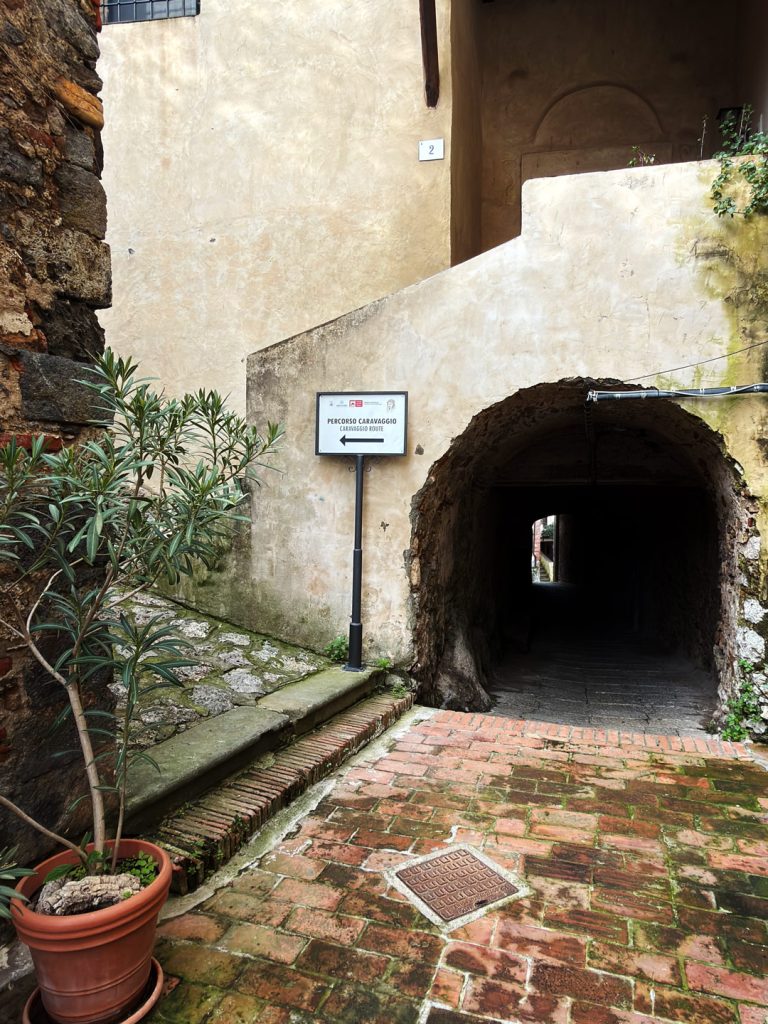
Head toward Piazza Santa Barbara and then climb the stairs through the archway
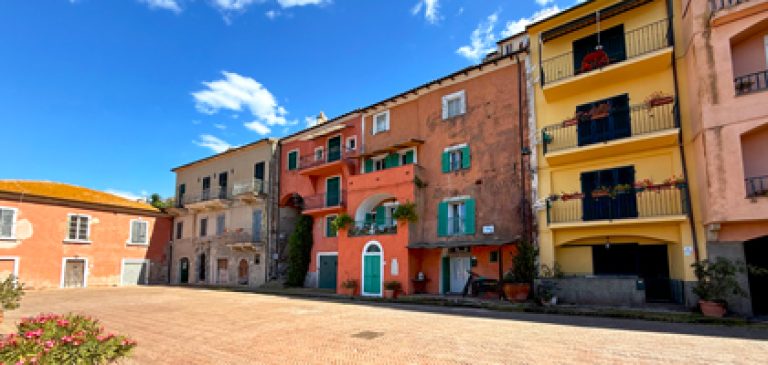
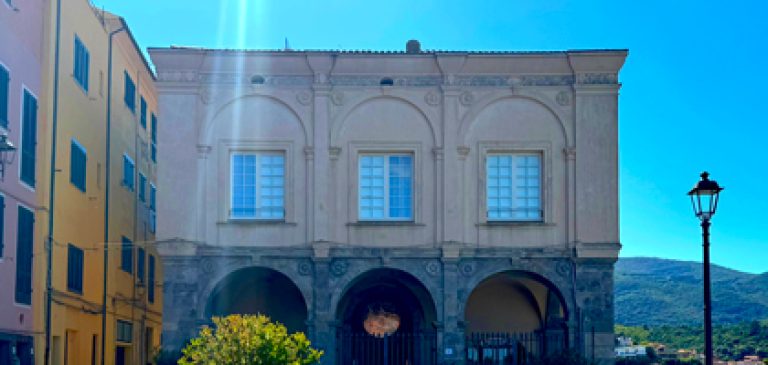
This small square is the center of the village. The Governor’s Palace — originally built in 1508 under the rule of Siena, then rebuilt by the Spanish after Barbarossa’s sack — occupies the main side of the village with its two-story façade, portico featuring three round arches, and stucco details that set it apart from every other building in the village. It served as the official residence of the governor of the Spanish garrison: from here, justice was administered, decrees were issued, and relations with Naples were managed. The upper loggia overlooks the entire bay—the harbor, the piers, and the open sea toward the Tyrrhenian Sea. It is likely that it was in this very building, or in its immediate vicinity, that Caravaggio sought help in his final days. It was 1610, and the governor of Porto Ercole held in his hands the life of the man whom the pope was about to pardon — but the pardon did not arrive in time.
Belvedere Garden
The View · Porto Ercole from Above
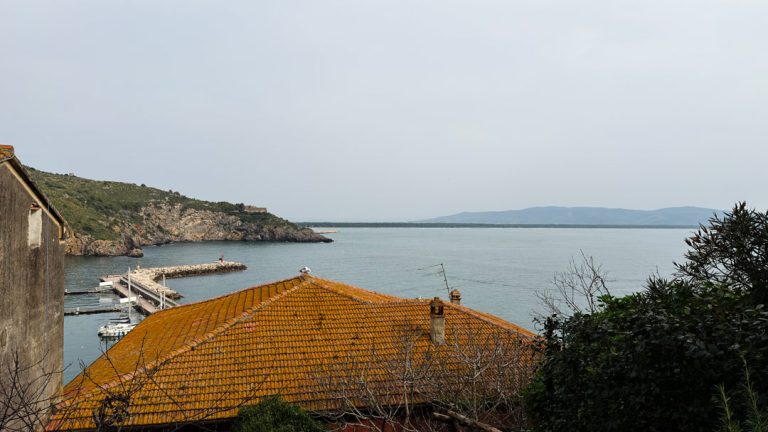
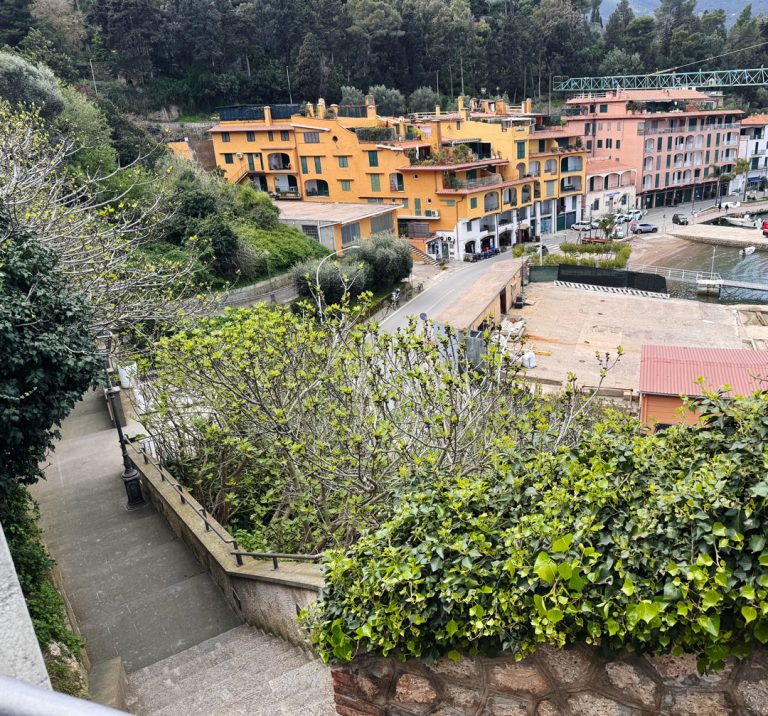
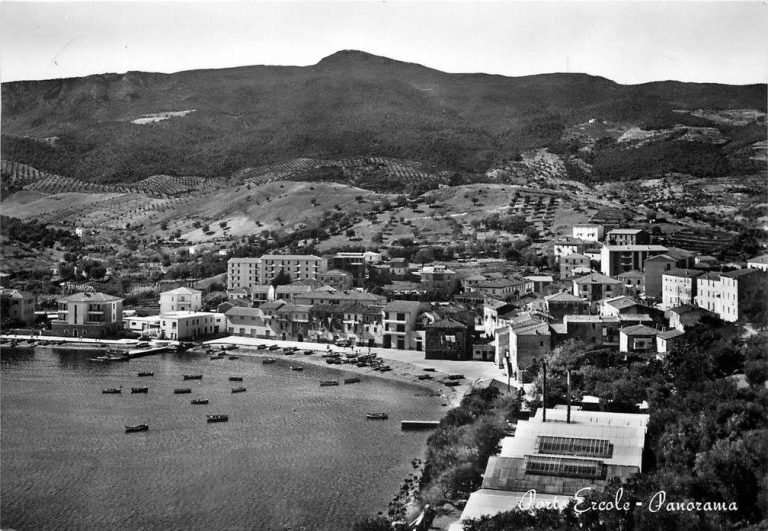
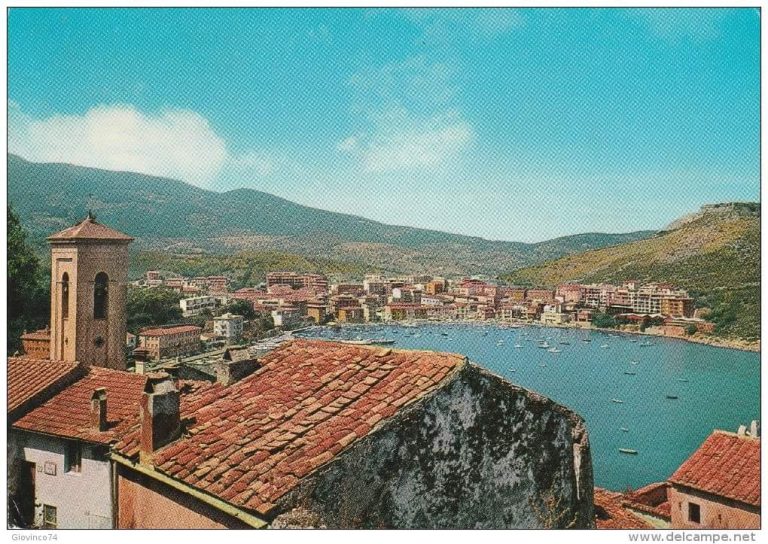
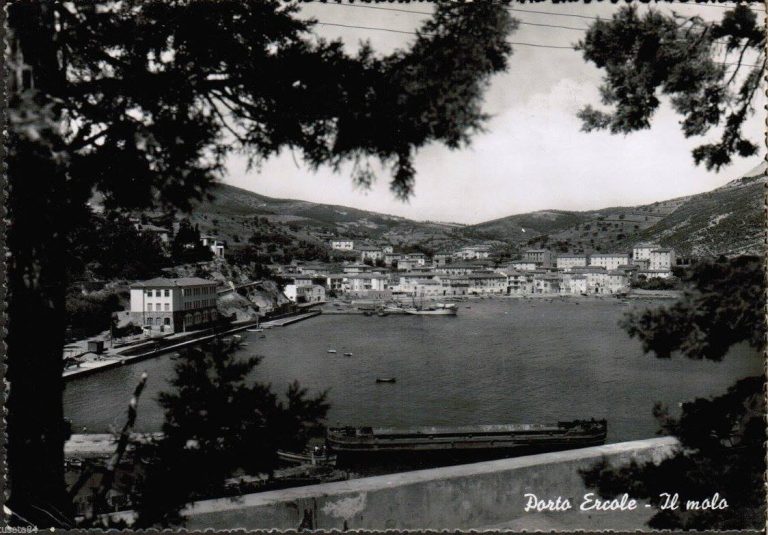
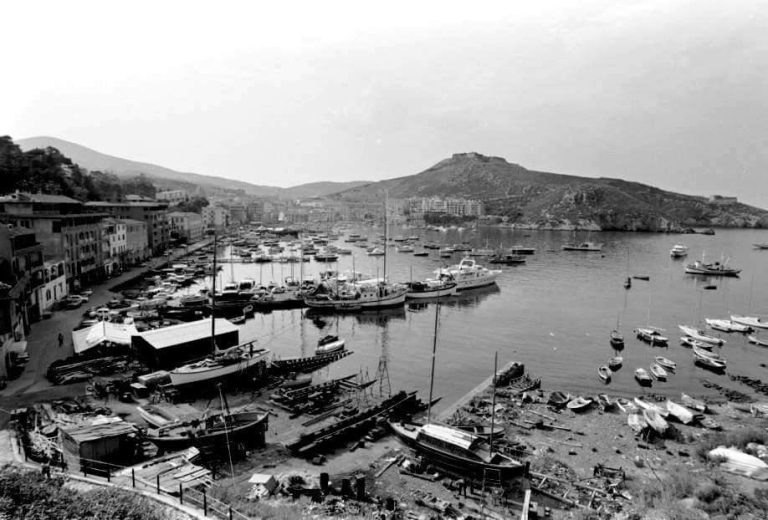
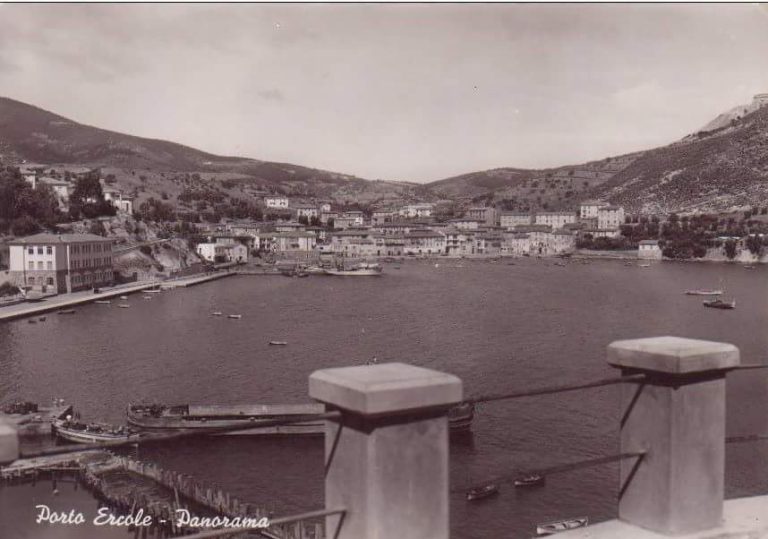
From this terrace, you can take in the whole view of Porto Ercole. The cove opens up below, with the piers and the harbor, the boats, and the waterfront. To the right, the Rocca Spagnolastands above the village, with its scarp walls and bastions designed by Francesco di Giorgio Martini and later Bernardo Buontalenti transformed from a medieval fortress into a masterpiece of Renaissance military architecture. To the left, high on the hill, the silhouette of Forte Filippo, built in 1558 by Giovanni Camerini by order of Philip II of Spain — impregnable, they said, and so it remained until the end. Further down, hidden among the rooftops, the Forte Stella with its six-pointed geometric shape. Three fortresses to defend a port. This was Porto Ercole: a stronghold on the Tyrrhenian Sea, a strategic checkpoint in the Spanish defensive system stretching from Naples to Milan. When Caravaggio arrived here in the summer of 1610, all this military apparatus was of no use. There was no enemy to fight. There was only a man dying.
Santa Croce Hospital and Torre Senese
Highest point of the route
This is where the story ends. TheSanta Croce Hospital — or Santa Maria Ausilinatrice, as the parish register calls it — is the place where Michelangelo Merisi died on July 18, 1610. The building is now a private residence. There isn’t much to see from the outside. But it is here that one of the most extraordinary and tormented lives in the history of European art came to an end. Caravaggio had left Naples on a felucca with three paintings intended for Cardinal Scipione Borghese — his ticket to papal pardon. During a stopover in Palo Laziale , he was arrested by mistake and detained. The felucca had departed without him. Once released, he made his way to Porto Ercole to retrieve the paintings and the boat, but it was already too late: the ship was gone. Suffering from fevers — malaria, according to the most widely accepted theories, perhaps aggravated by an infected wound — he was admitted to this hospital and never left. He was 38 years old. The Torre Senese next door, one of the few remaining structures from the period before the Spanish occupation, was already there when he arrived, and remained after he left. Stone lasts longer than human life.
Hanging Houses
Going down the staircase that runs along the walls
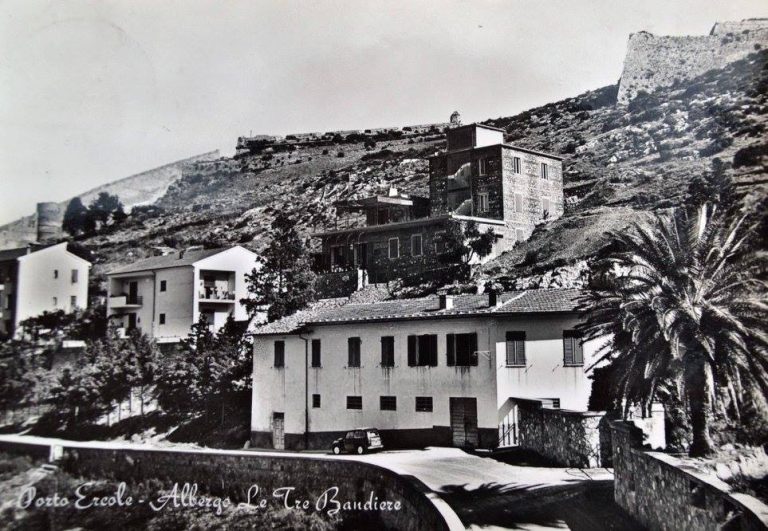
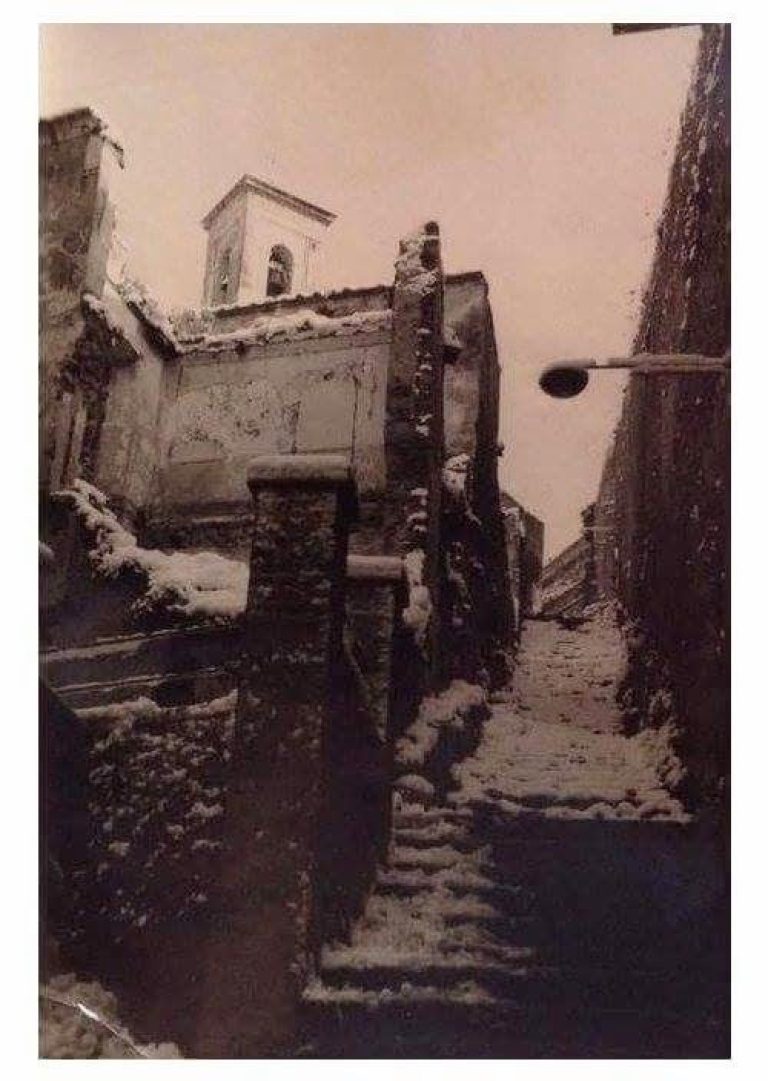
The “hanging houses” of Porto Ercole are one of the most fascinating architectural features of the village. Built directly on the limestone rock of the promontory, they seem to cling to the cliff face as if the sea had brushed past them but never quite reached them. This is no mere image: for centuries, this position was the only possible defense for the inhabitants. The streets of the historic center wind high up on the cliffs precisely to escape the dangers that came from the sea—pirates, raids, and enemy galleys. Every house was part of the village’s defensive system; every wall was also a bulwark. This logic, which we now perceive as an aesthetic virtue, was dictated by a vital necessity. The village of Porto Ercole that Caravaggio saw in the summer of 1610 was not very different from what we see today: the same narrow streets, the same buildings perched on the edge of the cliff, the same intertwining of history and stone. He walked through it feverish, searching for a ship that had already departed. We walk through it in an afternoon, searching for traces of those who came before us.
Back to the Waterfront
Walking down from Piazza Ricasoli
The circle closes here, where it began: on the waterfront, in front of the harbor. Porto Ercole did not become famous for Caravaggio right away. For centuries, his death here was all but ignored—a footnote in the biography of a controversial painter, in a provincial village that sought no such fame. Then came the critical reevaluation of the 20th century, and with it the realization of what this place held. Today, Porto Ercole is one of most beautiful villages in Italy, on July 18 the Caravaggio Festival, and the main avenue bears his name. The painter’s remains—identified in 2010 through DNA analysis by a group of international researchers—rest in the town cemetery. The journey you have just taken is not merely a stroll among the monuments of a historic village. It is an attempt to understand how a man—a fugitive, a genius, a man sentenced to death—chance upon a place, and how that place decided to remember him forever.
To provide the best possible experience, we use technologies such as cookies to store and/or access information on your device. By consenting to these technologies, we may process data such as your browsing behavior or unique identifiers on this site. Failure to consent or withdrawal of consent may adversely affect certain features.